
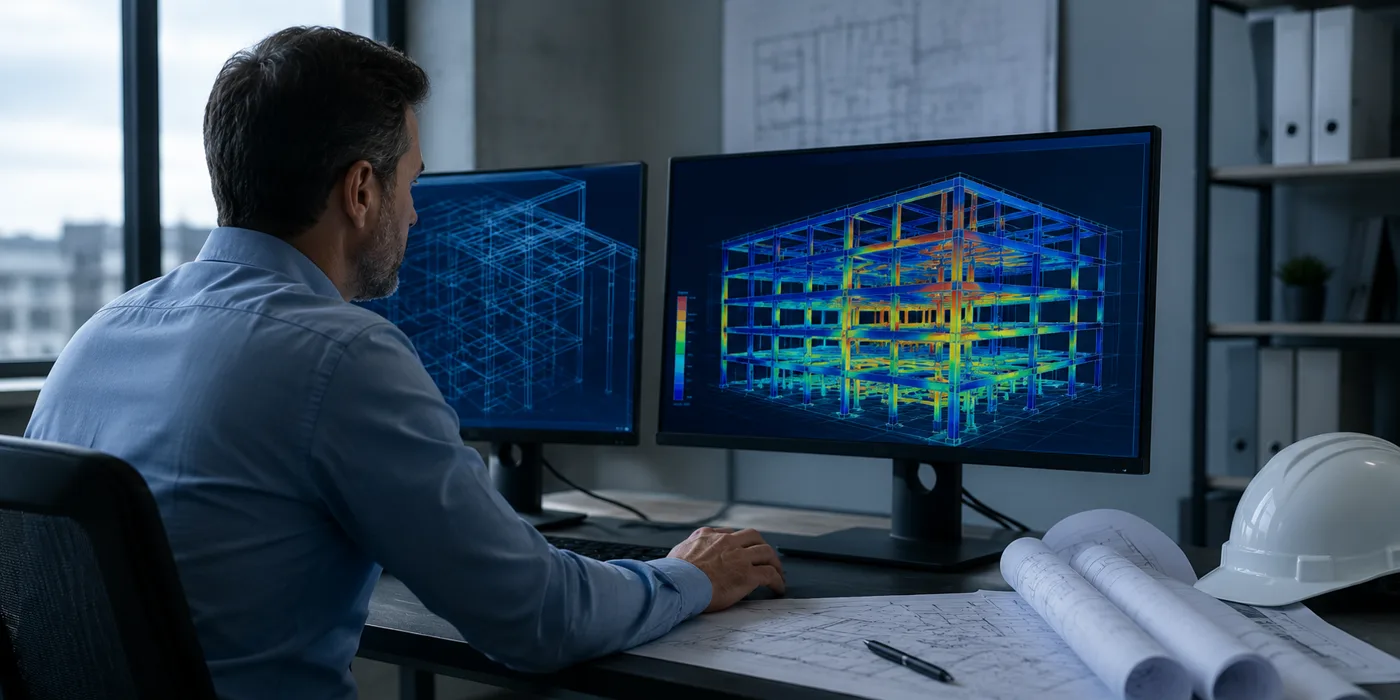
Artificial intelligence has moved from buzzword to a tool on the engineer’s desk. Used well, it does not replace judgment — it removes the repetitive work that slows projects down and hides costly errors, freeing licensed engineers to focus on the decisions that matter.
From manual checks to automated compliance
Verifying a design against hundreds of code provisions used to mean hours of line-by-line checking. AI-assisted tools now flag non-compliant members, missing load cases and detailing issues in seconds — not to overrule the engineer, but to make sure nothing slips through before a set goes out for permit.
Generative design and optimization
Given a set of constraints — spans, loads, materials, budget — generative tools can explore thousands of structural configurations and surface the most efficient options. Engineers then apply judgment to choose the scheme that best balances cost, constructability and the architectural intent. Less material, less waste, the same safety.
AI-driven quality control: catching errors before permit
The most valuable place AI earns its keep is quality control. By cross-checking drawings, calculations and models against each other, it catches inconsistencies — a beam that changed size in the model but not the plan, a connection that no longer matches its load — before they reach a plan reviewer or, worse, the field.
Why it matters: an error caught in the model costs minutes to fix. The same error caught at permit costs weeks — and caught in the field, it can cost a change order and a delayed opening.
Faster analysis, more iterations, better buildings
When analysis runs in minutes instead of days, engineers can test more options: a different framing layout, a lighter foundation, a value-engineering idea a client raised late in the process. More iterations, explored responsibly, mean better-performing and better-value buildings.
What AI does not replace
AI does not stamp drawings. A licensed professional engineer still owns every decision, reviews every output, and seals the work — because accountability, ethics and real-world judgment cannot be automated. The right model is simple: AI handles the repetitive and the checkable; the engineer owns the judgment and the responsibility.
How ISC puts AI to work
- Automated code and consistency checks on every set before it leaves our office.
- Optimization to reduce material and cost without touching safety margins.
- AI-assisted QC that catches drawing-to-model discrepancies early.
- Faster turnaround so clients keep moving — with a licensed engineer accountable at every step.